
Seasonal Field Notes
2011
Green-Dry Vegetation (May-Sept)
It was cool and windy May-Sept, typical of dry season weather. By July most of the vegetation was dry and the natural waterholes in the north-western region were dry. In Aug many of the Acacias were green with some of them blooming in Sept. There were a few showers in late Sept and within 72 hours some plants produced new shoots, and the temperature began to rise so hopefully the rains are on the way.
In August I saw a Fish Eagle feeding on a terrapin at the bank of a muddy waterhole.. This is the third time I've seen this behavior. Also in Aug. I found a male and female Somali Ostrich with 7 small chicks. This was a surprise as I hadn't seen Ostrich chicks in in this area for a long time. In early Sept large flocks of over 200 Red-Billed Quelea gathered east and west of Mzinga Hill.
Green Vegetation - Rains (Jan - Apr)
The Tsavo elephant aerial count was conducted in early Feb. The result was c.12,500 elephants within the 42,000 sq.km. Tsavo Ecosystem. There were 9 aircraft and it took 5 days, sometimes all day to finish the allocated blocks. While the days were long, I enjoyed seeing Tsavo from the air again and of course the elephants with many bull groups counted in my blocks.
It was hot and humid from Jan to Apr with heavy rainfall in mid-Feb and a few showers in March-April. A large flock of Carmin Bee- eaters arrived at Kanderi in Jan. swooping around the feet of three aggregations of elephants; which many of them tossed their trunk at the birds to get them to fly away.
2010
Green Vegetation - Rains (Nov - Dec)
The rains began in mid Nov. and although there was rainfall in Dec. they were patchy. By the end of Dec. most of Tsavo was green and many plants were blooming, but the majority of the waterholes in the bull area remained dry or had small pools. With the rains the migratory birds arrived in large flocks: Barn Swallows and Eurasian Rollers. By mid-Dec Steppe Eagles, Pallid and Montagu's Harriers and a large flock of Abdim's Storks had arrived.
Many species of wildlife were in the northwestern region, some in large groups: Gazelle, Hartebeest with the lone Topi, Impala, Eland, Giraffe, Buffalo and 2 prides of lions (4 and 13 individuals with 3 cubs).
Green-Dry Vegetation (May - Oct)
May was cool with a few light showers all month and by June it was windy and dry. In most areas the vegetation remained green until July. Although there were a few showers throughout the dry season it remained cool until mid-October when the temperature started to rise.
In the northwestern region of the park, large groups of different species were dispersed moving north-south and back again: Zebra, Hartebeest with a lone Fringe-eared Oryx, Giraffe, Somali and Common Ostrich, and the lone Topi with a group of Gazelle. Lions, with 4-8 individuals, were frequently seen in the western area during the dry season. In Oct many Warthog families were seen with 4-8 piglets.
Green Vegetation - Rains (Jan - Apr)
Rains were plentiful in most areas with high temperatures and little wind. Voi River had surface water for 4-5 days until the next storm. Bauhinia (shrub) and Ipomoea (creeper) were blooming creating a white blanket over many areas. In April the temperature began to drop with the winds starting - a sign of the beginning of the dry season.
Large flocks of Eurasian Rollers were in the northwest. More than 100 Open-billed Storks were seen on the bank of Aruba lake - a bull elephant 25 years old appeared intimidated by the large number - he took a quick drink and left. Two cheetahs were recorded at Kanderi running across the glade. Only a few Carmine Bee-eaters were in the Irima area this year. All of the waterholes and pans were full to overflowing. A lone Topi was recorded many times with Gazelle and Hartebeest in the glade west of Mwakingali and Irima Hills. Also in this region were large groups of Eland, Zebra and the Irima buffalo herd (200+), who were seen chasing a lioness.
2009
Green Vegetation - Rains (Oct - Dec)
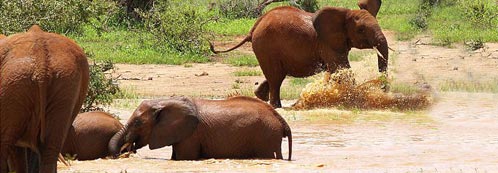
The first storm arrived early on the 10th of Oct. and within 72 hours the park was transformed from a harsh dry savanna to a lush area. Since that storm it rained every few days during Nov and Dec and the waterholes were full. The temperature was hot and humid. During the rains the Tsavo region is beautiful; blue sky, red roads, rust colored elephants (and zebra too), vivid green vegetation and flowers of many different colors. Insects began emerging from the soil in the hundreds in Nov and by Dec there were hundreds of butterflies.
Since all of the waterholes were full throughout the park, the wildlife dispersed and some gathered in large groups: Giraffe, Zebra, Gazelle and Eland. The migratory birds arrived in Nov; Barn Swallows, Eurasian Rollers, Steppe Eagles, Pallid and Montagu's Harrier and a few Carmine Bee-eaters.
Green-Dry Vegetation (May - Sept)
In late June the temperature started to drop and the winds picked-up. Galana River was flowing but due to lack of rain upcountry, the river was narrow in many places. The vegetation in most areas was dry and in some areas the ground was bare. Groups of Zebra and Eland had moved to patches of remaining green vegetation along the Voi Riverine. Although water was available in some areas, due to the lack of vegetation, some species had to travel long distances for food.
Dry-Green Vegetation (Jan - April)
Typically, during Jan and Feb the vegetation is green, the waterholes are full, and the temperature and humidity are high. Then in March the rains are expected to fall again until April or May. However this year the rains were late and it rained only in April. Subsequently those areas with little or no rain had golden, rather than green vegetation and in these areas the waterholes were dry by late January.
A few Eurasian Rollers and Carmine Bee-eaters came to Tsavo. A small flock of Bee- eaters were seen swooping around the feet of families of elephants to catch insects; the elephants, including the calves, tossed their trunk at the birds to move them away. In January three sub-adult Greater Flamingos and 40 White-faced Whistling Ducks were sighted at Aruba. With the lack of substantial rains, the majority of the migratory birds left Tsavo by March.
In February one Topi (rare sighting-believed to have emigrated to Tsavo East) was recorded with 8 Hartebeest west of Mzinga Hill. Also in February an Aardwolf dashed across the road south of Mudonda Rock. Three lionesses with one cub were sighted feeding on a warthog (not seen before, typically they kill buffalo or zebra).
2008
The Tsavo aerial count was conducted in Jan/Feb. We were based in Tsavo West with11 aircraft to cover the entire Tsavo Ecosystem. Each plane flew about 10 hours a day, within their assigned block, counting all wildlife including elephant carcasses and livestock. The total elephant count was c.11,600 within 42,000 sq. km. During the rains of 2008, the migratory birds returned to Tsavo: Pallid and Montagu's Harrier, Carmine Bee- eaters, Eurasian Rollers and Barn Swallows. During the dry season, August, a pack of 17 Wild Dogs with 4 pups, was recorded in the northwestern region of the park.